


Page 39 - Demo
P. 39
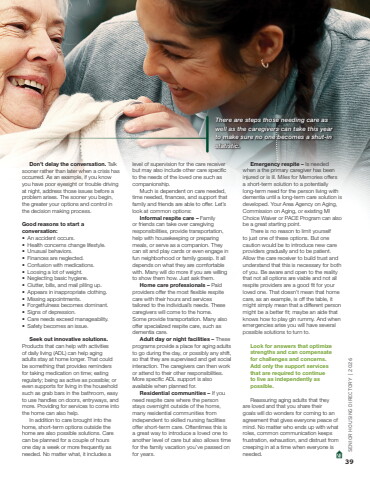
Don%u2019t delay the conversation. Talk sooner rather than later when a crisis has occurred. As an example, if you know you have poor eyesight or trouble driving at night, address those issues before a problem arises. The sooner you begin, the greater your options and control in the decision making process. Good reasons to start a conversation:%u2022 An accident occurs.%u2022 Health concerns change lifestyle. %u2022 Unusual behaviors.%u2022 Finances are neglected. %u2022 Confusion with medications.%u2022 Loosing a lot of weight.%u2022 Neglecting basic hygiene.%u2022 Clutter, bills, and mail pilling up.%u2022 Appears in inappropriate clothing.%u2022 Missing appointments.%u2022 Forgetfulness becomes dominant.%u2022 Signs of depression.%u2022 Care needs exceed manageability.%u2022 Safety becomes an issue.Seek out innovative solutions. Products that can help with activities of daily living (ADL) can help aging adults stay at home longer. That could be something that provides reminders for taking medication on time; eating regularly; being as active as possible; or even supports for living in the household such as grab bars in the bathroom, easy to use handles on doors, entryways, and more. Providing for services to come into the home can also help. In addition to care brought into the home, short-term options outside the home are also possible solutions. Care can be planned for a couple of hours one day a week or more frequently as needed. No matter what, it includes a level of supervision for the care receiver but may also include other care specific to the needs of the loved one such as companionship. Much is dependent on care needed, time needed, finances, and support that family and friends are able to offer. Let%u2019s look at common options: Informal respite care %u2013 Family or friends can take over caregiving responsibilities, provide transportation, help with housekeeping or preparing meals, or serve as a companion. They can sit and play cards or even engage in fun neighborhood or family gossip. It all depends on what they are comfortable with. Many will do more if you are willing to show them how. Just ask them. Home care professionals %u2013 Paid providers offer the most flexible respite care with their hours and services tailored to the individual%u2019s needs. These caregivers will come to the home. Some provide transportation. Many also offer specialized respite care, such as dementia care.Adult day or night facilities %u2013 These programs provide a place for aging adults to go during the day, or possibly any shift, so that they are supervised and get social interaction. The caregivers can then work or attend to their other responsibilities. More specific ADL support is also available when planned for. Residential communities %u2013 If you need respite care where the person stays overnight outside of the home, many residential communities from independent to skilled nursing facilities offer short-term care. Oftentimes this is a great way to introduce a loved one to another level of care but also allows time for the family vacation you%u2019ve passed on for years. Emergency respite %u2013 Is needed when a the primary caregiver has been injured or is ill. Miles for Memories offers a short-term solution to a potentially long-term need for the person living with dementia until a long-term care solution is developed. Your Area Agency on Aging, Commission on Aging, or existing MI Choice Waiver or PACE Program can also be a great starting point. There is no reason to limit yourself to just one of these options. But one caution would be to introduce new care providers gradually and to be patient. Allow the care receiver to build trust and understand that this is necessary for both of you. Be aware and open to the reality that not all options are viable and not all respite providers are a good fit for your loved one. That doesn%u2019t mean that home care, as an example, is off the table, it might simply mean that a different person might be a better fit; maybe an aide that knows how to play gin rummy. And when emergencies arise you will have several possible solutions to turn to. Look for answers that optimize strengths and can compensate for challenges and concerns. Add only the support services that are required to continue to live as independently as possible.Reassuring aging adults that they are loved and that you share their goals will do wonders for coming to an agreement that gives everyone peace of mind. No matter who ends up with what roles, common communication keeps frustration, exhaustion, and distrust from creeping in at a time when everyone is needed.There are steps those needing care as well as the caregivers can take this year to make sure no one becomes a shut-in statistic.SENIOR HOUSING DIRECTORY | 202639


