


Page 24 - Scene Magazine January 2024 4901
P. 24
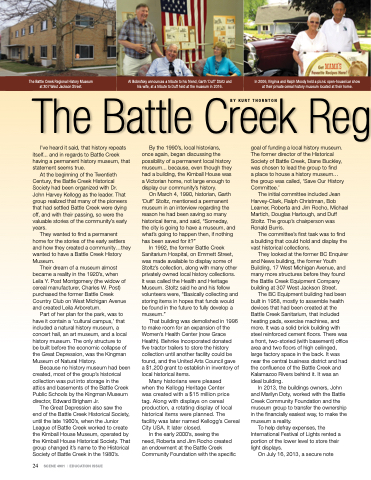
 The Battle Creek Regional History Museum at 307 West Jackson Street.
Al Bobrofsky announces a tribute to his friend, Garth ‘Duff’ Stoltz and his wife, at a tribute to Duff held at the museum in 2016.
 In 2006, Virginia and Ralph Moody held a picnic open-house/car show at their private cereal history museum located at their home.
I’ve heard it said, that history repeats itself... and in regards to Battle Creek having a permanent history museum, that statement seems true.
At the beginning of the Twentieth Century, the Battle Creek Historical Society had been organized with Dr. John Harvey Kellogg as the leader. That group realized that many of the pioneers that had settled Battle Creek were dying off, and with their passing, so were the valuable stories of the community’s early years.
They wanted to find a permanent home for the stories of the early settlers and how they created a community...they wanted to have a Battle Creek History Museum.
Their dream of a museum almost became a reality in the 1920’s, when Leila Y. Post Montgomery (the widow of cereal manufacturer, Charles W. Post) purchased the former Battle Creek Country Club on West Michigan Avenue and created Leila Arboretum.
Part of her plan for the park, was to have it contain a ‘cultural campus,’ that included a natural history museum, a concert hall, an art museum, and a local history museum. The only structure to
By the 1990’s, local historians, once again, began discussing the possibility of a permanent local history museum... because, even though they had a building, the Kimball House was a Victorian home, not large enough to display our community’s history.
On March 4, 1990, historian, Garth ‘Duff’ Stoltz, mentioned a permanent museum in an interview regarding the reason he had been saving so many historical items, and said, “Someday, the city is going to have a museum, and what’s going to happen then, if nothing has been saved for it?”
In 1992, the former Battle Creek Sanitarium Hospital, on Emmett Street, was made available to display some of Stoltz’s collection, along with many other privately owned local history collections. It was called the Health and Heritage Museum. Stoltz said he and his fellow volunteers were, “Basically collecting and storing items in hopes that funds would be found in the future to fully develop a museum.”
That building was demolished in 1996 to make room for an expansion of the Women’s Health Center (now Grace Health). Behnke Incorporated donated
goal of funding a local history museum. The former director of the Historical Society of Battle Creek, Diane Buckley, was chosen to lead the group to find
a place to house a history museum... the group was called, ‘Save Our History Committee.’
The initial committee included Jean Harvey-Clark, Ralph Christman, Bob Learner, Roberta and Jim Rocho, Michael Martich, Douglas Hartough, and Duff Stoltz. The group’s chairperson was Ronald Burris.
The committee’s first task was to find a building that could hold and display the vast historical collections.
They looked at the former BC Enquirer and News building, the former Youth Building, 17 West Michigan Avenue, and many more structures before they found the Battle Creek Equipment Company building at 307 West Jackson Street.
The BC Equipment building had been built in 1958, mostly to assemble health devices that had been created at the Battle Creek Sanitarium, that included heating pads, exercise machines, and more. It was a solid brick building with steel reinforced cement floors. There was a front, two-storied (with basement) office
The Battle Creek Reg
 BY KURT THORNTON
be built before the economic collapse of the Great Depression, was the Kingman Museum of Natural History.
Because no history museum had been created, most of the group’s historical collection was put into storage in the attics and basements of the Battle Creek Public Schools by the Kingman Museum director, Edward Brigham Jr.
The Great Depression also saw the end of the Battle Creek Historical Society, until the late 1960’s, when the Junior League of Battle Creek worked to create the Kimball House Museum, operated by the Kimball House Historical Society. That group changed it’s name to the Historical Society of Battle Creek in the 1980’s.
24 SCENE 4901 I EDUCATION ISSUE
five tractor trailers to store the history collection until another facility could be found, and the United Arts Council gave a $1,200 grant to establish in inventory of local historical items.
Many historians were pleased
when the Kellogg Heritage Center
was created with a $15 million price tag. Along with displays on cereal production, a rotating display of local historical items were planned. The facility was later named Kellogg’s Cereal City USA. It later closed.
In the early 2000’s, seeing the
need, Roberta and Jim Rocho created an endowment at the Battle Creek Community Foundation with the specific
area and two floors of high ceilinged, large factory space in the back. It was near the central business district and had the confluence of the Battle Creek and Kalamazoo Rivers behind it. It was an ideal building.
In 2013, the buildings owners, John and Marilyn Doty, worked with the Battle Creek Community Foundation and the museum group to transfer the ownership in the financially easiest way, to make the museum a reality.
To help defray expenses, the International Festival of Lights rented a portion of the lower level to store their light displays.
On July 16, 2013, a secure note


