


Page 24 - Scene Magazine March 2022 47-03
P. 24
  For Your Health
BY LAUREN LEWANDOWSKI, Epidemiologist
   The Importance of the Community Health Needs Assessment and Operationalizing its Findings
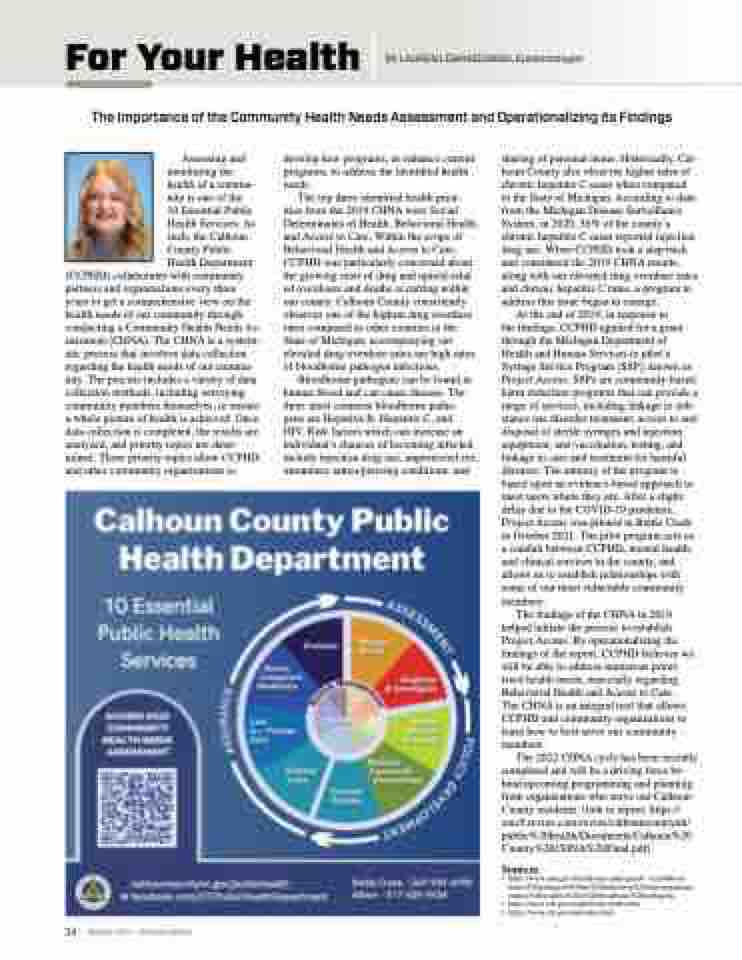
Assessing and monitoring the health of a commu- nity is one of the 10 Essential Public Health Services. As such, the Calhoun County Public Health Department
(CCPHD) collaborates with community partners and organizations every three years to get a comprehensive view on the health needs of our community through conducting a Community Health Needs As- sessment (CHNA). The CHNA is a system- atic process that involves data collection regarding the health needs of our commu- nity. The process includes a variety of data collection methods, including surveying community members themselves, to ensure a whole picture of health is achieved. Once data collection is completed, the results are analyzed, and priority topics are deter- mined. These priority topics allow CCPHD and other community organizations to
develop new programs, or enhance current programs, to address the identified health needs.
sharing of personal items. Historically, Cal- houn County also observes higher rates of chronic hepatitis C cases when compared to the State of Michigan. According to data from the Michigan Disease Surveillance System, in 2020, 56% of the county’s chronic hepatitis C cases reported injection drug use. When CCPHD took a step back and considered the 2019 CHNA results, along with our elevated drug overdose rates and chronic hepatitis C rates, a program to address this issue began to emerge.
At the end of 2019, in response to
the findings, CCPHD applied for a grant through the Michigan Department of Health and Human Services to pilot a Syringe Service Program (SSP), known as Project Access. SSPs are community-based harm reduction programs that can provide a range of services, including linkage to sub- stance use disorder treatment; access to and disposal of sterile syringes and injection equipment; and vaccination, testing, and linkage to care and treatment for harmful diseases. The entirety of the program is based upon an evidence-based approach to meet users where they are. After a slight delay due to the COVID-19 pandemic, Project Access was piloted in Battle Creek in October 2021. The pilot program acts as a conduit between CCPHD, mental health, and clinical services in the county, and allows us to establish relationships with some of our most vulnerable community members.
 24 SCENE 4703 I HEALTH ISSUE
The top three identified health prior- ities from the 2019 CHNA were Social Determinants of Health, Behavioral Health, and Access to Care. Within the scope of Behavioral Health and Access to Care, CCPHD was particularly concerned about the growing rates of drug and opioid-relat- ed overdoses and deaths occurring within our county. Calhoun County consistently observes one of the highest drug overdose rates compared to other counties in the State of Michigan; accompanying our elevated drug overdose rates are high rates of bloodborne pathogen infections.
Bloodborne pathogens can be found in human blood and can cause disease. The three most common bloodborne patho- gens are Hepatitis B, Hepatitis C, and
HIV. Risk factors which can increase an individual’s chances of becoming infected include injection drug use, unprotected sex, unsanitary tattoo/piercing conditions, and
 The findings of the CHNA in 2019 helped initiate the process to establish Project Access. By operationalizing the findings of the report, CCPHD believes we will be able to address numerous priori- tized health needs, especially regarding Behavioral Health and Access to Care. The CHNA is an integral tool that allows CCPHD and community organizations to learn how to best serve our community members.
The 2022 CHNA cycle has been recently completed and will be a driving force be- hind upcoming programming and planning from organizations who serve our Calhoun County residents. (link to report: https:// cms5.revize.com/revize/calhouncountymi/ public%20health/Documents/Calhoun%20 County%20CHNA%20Final.pdf)
Sources
• https://www.osha.gov/bloodborne-pathogens#:~:text=Blood- borne%20pathogens%20are%20infectious%20microorganisms,- expose%20workers%20to%20bloodborne%20pathogens.
• https://www.cdc.gov/hepatitis/abc/index.htm • https://www.cdc.gov/ssp/index.html


