


Page 10 - Scene Magazine November 2021 45-11
P. 10
  Health Scene
DR. LINDSAY BLISS, vascular neurologist at Bronson Neuroscience Center in Kalamazoo
DR. RYAN YODER, neurologist at Bronson Neuroscience Center in Battle Creek
   As one of the leading causes of death in the United States, recognizing the signs of stroke may save your life. On average, one American dies from stroke every four minutes. Learn more about the warning signs and talk to your doctor about tips and tricks to stay healthy.
work with your doctor to lower it.
• Ask your doctor if you have atrial fibril-
What is a Stroke? A stroke happens when blood flow to the brain stops. There are two types of stroke: ischemic and hemorrhagic.
• Ischemic stroke is caused when plaque
so, work with your doctor to control it. • If you are diabetic, work with your doc- tor to control your overall blood sugars.
Support After a Stroke – If you or a loved one has experienced a stroke, recov- ery can feel lonely at times. But it doesn’t have to be. Join the virtual Bronson Stroke Support Group to learn more about the effects of stroke, tools for coping, and resources for survivors and caregivers. Each month, there are speakers, educa- tional topics, and open discussion related to stroke.
or clots block a blood vessel in your brain or neck. It is the most common type of stroke.
• Enjoy a lower salt, lower fat diet.
• Ask your doctor how you can lower
• Hemorrhagic stroke is caused when a vessel in your brain breaks causing bleeding in the brain.
Call 911 and get to a Hospital
Fast – During a stroke, time is vital. It’s important to call 9-1-1 right away so first responders can make sure the stroke team at Bronson Battle Creek Hospital is ready the moment you arrive. Treatment re- quires a trained medical team that can act quickly to administer powerful medicine. The medicine, often a clot-busting drug called tPA (tissue plasminogen activator), can reduce or reverse blocked blood flow before it causes long lasting brain damage.
At the support group, you will:
Risk Factors
• Find someone who understands what you’ve been through.
• Advanced age: most strokes occur in people age 65 years or older, but they can occur at any age.
• Find out that you’re not alone in this recovery process – many people of all ages have traveled this road.
• Family history of stroke.
• Ethnicity: African-Americans have a
• Learn from others and teach them something valuable, too.
higher stroke risk.
• Gender: women have more strokes than
Recognize the Signs of a Stroke
• Medical conditions: blood pressure lev- els, atrial fibrillation, cholesterol levels and diabetes.
stroke care. If more complex treatment is needed, you’ll be quickly transferred to a team of stroke specialists at Bronson Methodist Hospital.
  Dr. Lindsay Bliss
  Dr. Ryan Yoder
• Lifestyle choices: tobacco use or smok- ing and alcohol use.
New Technology Helps Save More
of Your Brain – To help someone who’s had a stroke, it’s always been important
to know when the stroke started. In the past, a clot removal procedure – called a thrombectomy – was only safe within the first six hours of the start of a stroke. To- day, time is still critical to save brain cells. However, using a new advanced imaging technology called RAPID we can now quickly and easily take a picture of the brain and see if it’s still safe to remove the clot – regardless of if it’s been six hours or more (up to 24 hours).
Reduce Your Stroke Risk – You can take steps to help lower your stroke risk: • Know your blood pressure. If high,
lation (irregular heartbeat).
• If you smoke, stop.
• If you drink alcohol, limit to no more
than two drinks per day.
• Find out if you have high cholesterol. If
• Move more. Include exercise and physi- cal activities you enjoy in your daily routine.
your stroke risk.
The support group meets online on
the third Thursday of the month from 11am-noon. It’s led by Jamie Warner, RN, stroke nurse navigator at Bronson Neuro- science Center. For more information, call (269) 341-7500.
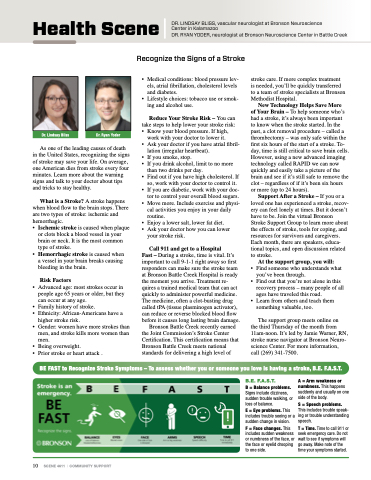
BE FAST to Recognize Stroke Symptoms – To assess whether you or someone you love is having a stroke, B.E. F.A.S.T.
men, and stroke kills more women than
Bronson Battle Creek recently earned the Joint Commission’s Stroke Center Certification. This certification means that Bronson Battle Creek meets national standards for delivering a high level of
men.
• Being overweight.
• Prior stroke or heart attack .
 B.E. F.A.S.T.
B = Balance problems.
Signs include dizziness, sudden trouble walking, or loss of balance.
E = Eye problems. This includes trouble seeing or a sudden change in vision.
F = Face changes. This includes sudden weakness or numbness of the face, or the face or eyelid drooping to one side.
A = Arm weakness or numbness. This happens suddenly and usually on one side of the body.
S = Speech problems.
This includes trouble speak- ing or trouble understanding speech.
T = Time. Time to call 911 or seek emergency care. Do not wait to see if symptoms will go away. Make note of the time your symptoms started.
  10
SCENE 4611 I COMMUNITY SUPPORT


